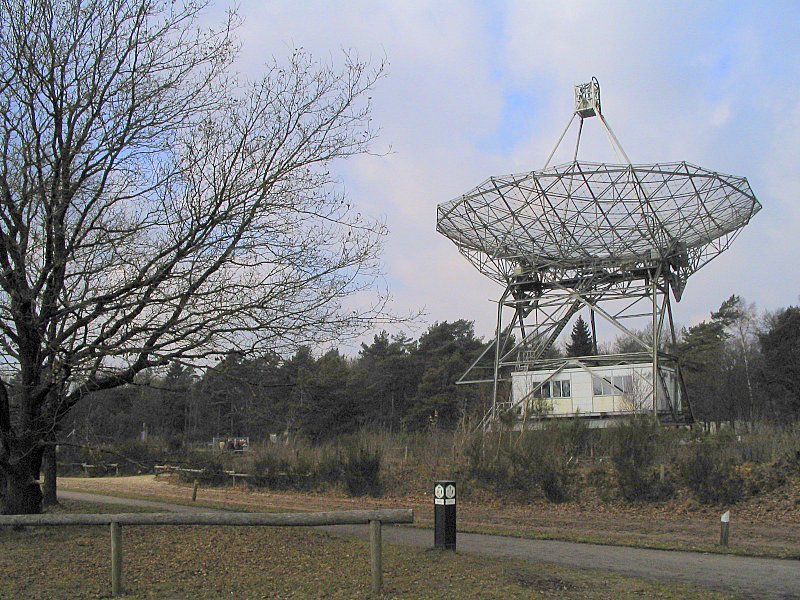
On the edge of Dwingelderveld National Park, the Dwingeloo Radio Telescope unfolds its monumental dish. A true icon of Dutch radio astronomy, it blends scientific heritage, industrial history and public experiences offered during open days.
Galerie photos
Harm Munk, CC BY-SA 3.0, via Wikimedia Commons
History & science
Put into operation in the mid-1950s, the telescope played a key role in the early days of modern radio astronomy in the Netherlands. It helped map the sky in radio waves and explore regions obscured by dust in the Milky Way, revealing galaxies and structures invisible to the naked eye.
Architecture & engineering
The parabolic dish (around 25 metres in diameter) is mounted on a steerable structure that allows precise tracking of radio sources. Its imposing mechanics, latticework of beams and walkways make it a prime example of post-war scientific engineering.
A lively site
After restoration, the site is now run by enthusiasts who organise demonstrations and workshops during open days. Visitors can learn how an antenna detects signals from the Moon, the Sun or the interstellar medium, and understand the difference between optical astronomy and radio astronomy.
Visitor experience
- Demonstrations (on selected dates): antenna pointing, explanations on signal detection.
- Walk around the site: the dish stands out against the heathlands and forests of Dwingelderveld — an ideal photo spot.
- Education: clear resources explaining wavelengths, spectra and radio maps of the sky.
Practical information
Location: near Dwingeloo (Drenthe), on the edge of Dwingelderveld National Park. Access by car or bicycle (limited parking). Guided tours and open days take place occasionally — check the schedule before visiting.
Tips
- Wear proper footwear to combine your visit with a walk in the park.
- Arrive early on open days: it can get busy.
- Ideal for families and science enthusiasts, even without prior knowledge.