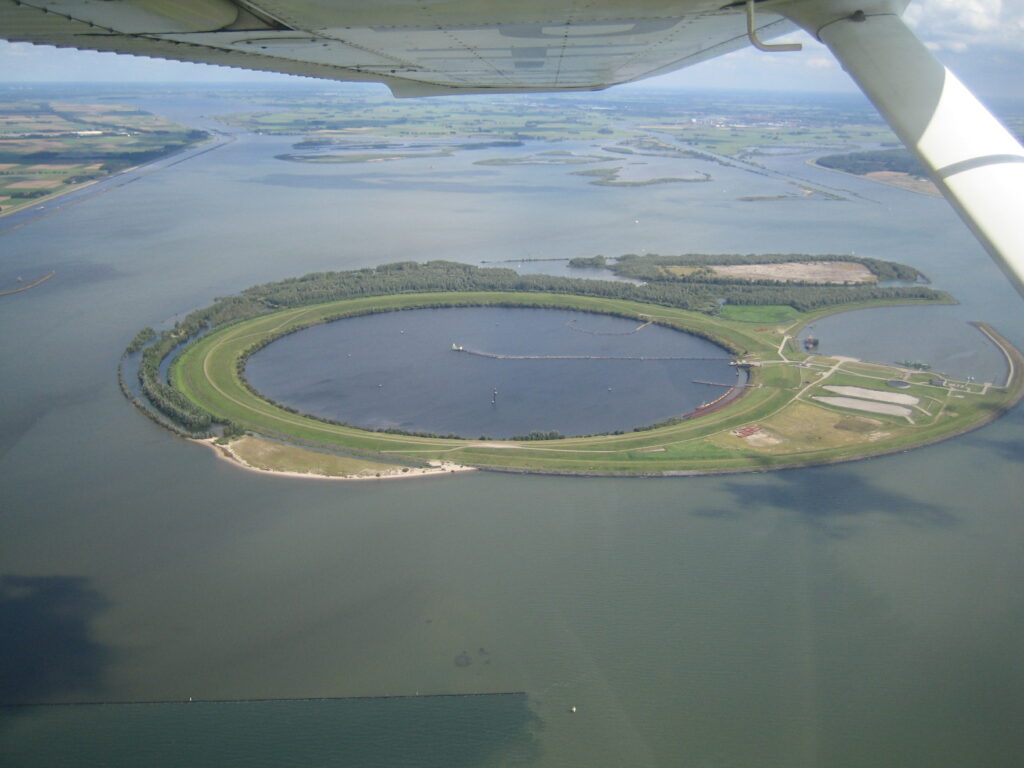
IJsseloog is a fascinating example of Dutch engineering: a perfectly circular artificial island in the heart of the Ketelmeer, created to store polluted sediments from the IJssel River. Today, the site combines technical ingenuity, ecology and geometric beauty, while remaining inaccessible to the public.
Galerie photos
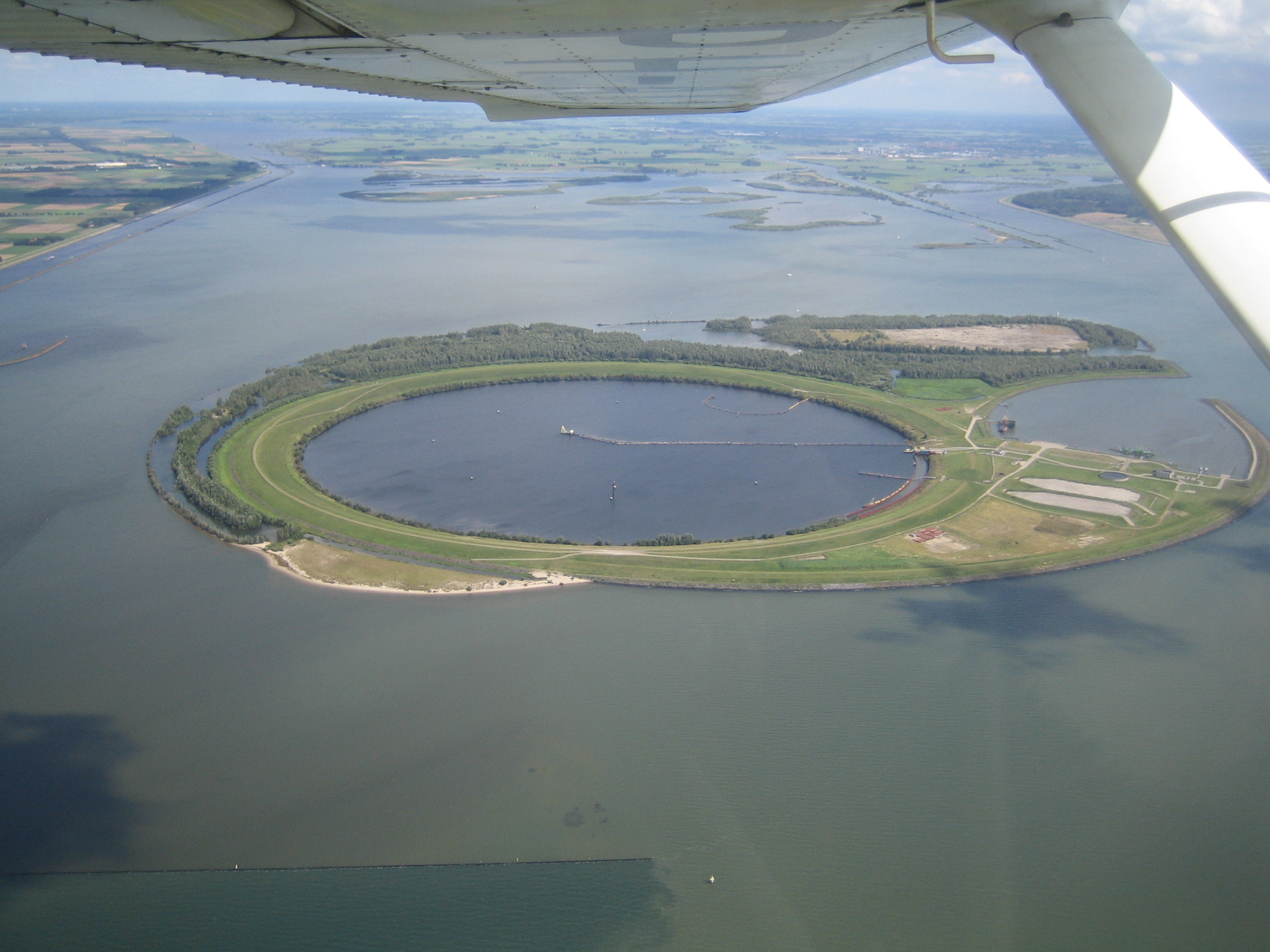
Albert kok, CC BY-SA 3.0, via Wikimedia Commons
Description
In the middle of the Ketelmeer, a perfect circle floats on the water: IJsseloog. This ring-shaped artificial island was created to store polluted sediments from the IJssel River. Combining hydraulic engineering and ecological renewal, it is now a fascinating site both for its form and its symbolism.
A one-of-a-kind engineering project
Built between 1996 and 1999, IJsseloog (literally “the eye of the IJssel”) is a feat of civil engineering. The island forms a circular ring one kilometre in diameter and contains at its centre a deep storage basin of 45 metres. This reservoir holds contaminated sludge while preventing any contact with the waters of the Ketelmeer, thanks to a water level kept more than four metres below NAP.
Origin and purpose
For decades, industries in the Netherlands and Germany discharged heavy metals such as mercury and zinc into the IJssel. These residues accumulated on the bottom of the Ketelmeer, threatening wildlife and water quality. To prevent their dispersion toward the IJsselmeer, Rijkswaterstaat devised this innovative solution: an isolated storage site in the middle of the lake, far from inhabited areas.
Construction and features
The island was excavated directly into the bed of the Ketelmeer and surrounded by a ten-metre-high dike. Its total capacity reaches around 20 million m³ of sediment. During the works, teams uncovered ancient glacial boulders and 25,000-year-old mammoth bones, a reminder of the prehistoric landscape that preceded the modern polder.
A new ecosystem
To offset the impact of construction, two natural islands were created: Schokkerbank and Hanzeplaat. Now refuges for waterbirds, they host swans, barnacle geese, spoonbills and scaups. Other islets, such as Ramspolplaat and Kampenplaat, were later added to strengthen biodiversity around the IJssel estuary.
An eye on nature
Seen from above, IJsseloog looks like a giant eye set on the lake — a powerful image for a project born from the desire to monitor and protect the environment. The island remains uninhabited and closed to the public, but its perfect shape continues to intrigue photographers, mapmakers and curious visitors from around the world.